itaobuy Trench Coat Spreadsheet Guide
itaobuy Trench Coat Spreadsheet Guide
A commuter trench coat can't be chosen solely based on product photos or descriptions like "relaxed fit." What actually affects the outcome is your commuting route, body type, inner layer thickness, weather, coat length, and the actual size data provided on the product page.
This guide helps you organize trench coat entries from the itaobuy Spreadsheet into a verifiable candidate list, then return to the product pages currently accessible on itao-buy.com to confirm size, material, stock, and purchase conditions. This article does not provide unverified specific product recommendations, nor does it apply to scenarios requiring professional waterproof, cold-weather, or labor protection clothing.
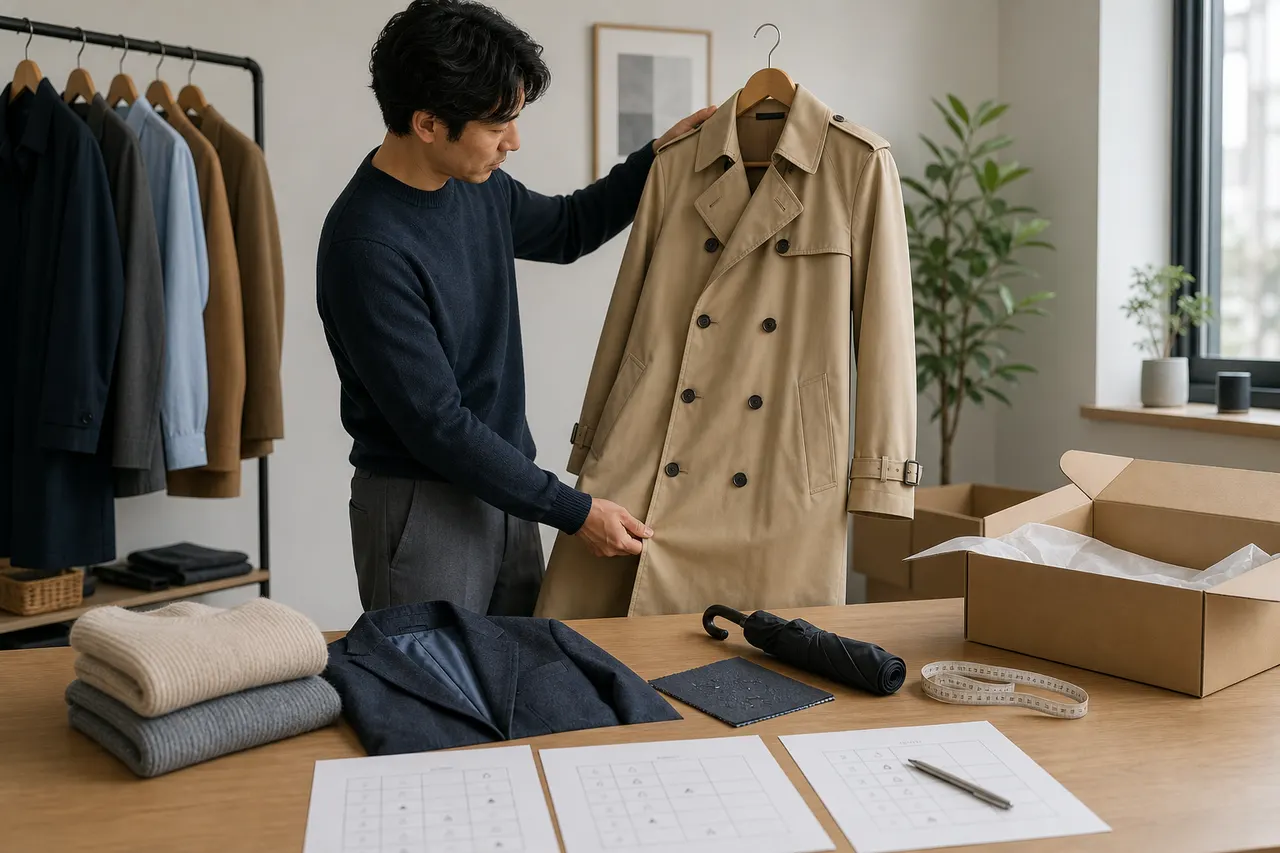
First Define Your Commuting Route, Season, and Inner Layer Thickness
Before filtering, write down your actual usage conditions, not starting with color or styling.
Commuting method: walking, cycling, public transit, or driving
Time outdoors: only short movement between stops, or needing to walk 20-30 minutes daily
Season of wear: warm and rainy transitional season, dry and windy autumn, or early winter requiring layering
Common inner layers: shirt, thin knit, blazer, hoodie, or lightweight down jacket
Personal items: phone, access card, earphones, folding umbrella, and commuter bag
Those who frequently cycle or walk briskly need to pay attention to hem movement space, vents, and cuff adjustment; those mainly driving should be wary of overly long hems bunching on the seat. When needing to cover a blazer, chest, shoulder, and armhole allowance are usually more important than waist measurement. 🌦️
Finally, compress your needs into one actionable condition, for example: "For spring/autumn public transit commuting, with shirt and thin knit inner layers, hoping to cover the upper thigh, without tightness when raising arms or carrying a backpack."
What the Spreadsheet Can Provide for Filtering Clues and Its Information Boundaries
The Spreadsheet is suitable for discovering candidate products, recording links, and making preliminary comparisons, but it is not the final evidence of product status. Titles, sizes, prices, materials, or images in the spreadsheet may be incomplete or may be earlier than the current product page.
Spreadsheet information can be divided into three categories:
Usable for initial screening: style name, color, marked size, length clues, images, and product links
Must be verified on the product page: on-sale status, specification options, size chart, material markings, price, and seller notes
Usually requires further evidence: physical dimensions, color deviation, stitching condition, fabric surface, pocket depth, and actual package volume
The verification baseline date for this article is August 27, 2026, but no product samples have been provided for item-by-item verification, so no spreadsheet field can be considered confirmed fact. Before ordering, the same-day visible page on itao-buy.com, order confirmation interface, and rules applicable to that order shall prevail; links that are invalid, redirect abnormally, lack a clear product name, or lack necessary information should be removed from the candidate list.
Establish Candidate Conditions by Length, Shoulder Type, and Silhouette
First, measure a coat that fits you well. Lay it flat, record length, chest width, shoulder width, and sleeve length, then compare with candidate products using the same measurement method. Do not directly confuse body chest circumference with flat chest width.
Coat length should be judged in conjunction with height and commuting movements:
Short or near-hip styles are convenient for movement but provide limited wind and rain coverage for legs
Length near mid-thigh is usually easier to balance coverage and getting in/out of vehicles
Knee-length or longer styles provide more coverage but may bunch on stairs, when cycling, and when sitting
Shoulder type changes size judgment. Set-in shoulder designs require more accurate shoulder width matching; dropped shoulder designs have higher tolerance but cannot automatically prove sleeve length is correct. Raglan sleeves should focus on how the measurement is marked from collar to cuff and whether there is enough underarm movement space.
Regarding silhouette, straight-cut styles are usually easier to accommodate stable commuting inner layers; styles with obvious waist shaping need to check chest, waist, and hip positions simultaneously; labels like loose or cocoon are only clues and cannot replace centimeter measurements. 📏
Use Inner Layer Dimensions to Judge Chest and Armhole Allowance
First put on the thickest planned inner layer, then measure body chest circumference, or directly measure the garment width of the outer layer over this inner layer. If you often wear a blazer while commuting, use the blazer's outer measurements as reference, not just the shirt state.
When building candidate records, you can use the following verification table:
Verification Item | Record Content | Elimination Signal |
|---|---|---|
Chest | Thickest inner layer size, trench coat garment size, estimated allowance | Only S/M/L, no corresponding centimeter data |
Shoulders | Shoulder type, shoulder width, or raglan measurement method | Measurement start/end points unclear, cannot compare with existing coat |
Armhole | Whether it can accommodate blazer, hoodie, or knit layer | Photo shows obvious pulling, but no size evidence to explain |
Sleeve length | Sleeve length number, whether cuff adjustable | Only model effect, lacking model conditions or actual size |
Hips and hem | Space needed for sitting, stepping, and buttoning | Obvious waist shaping, but no waist/hip measurements |
If the size chart only gives recommended height or weight, it is insufficient to resolve shoulder width, chest circumference, and inner layer thickness issues. Size letters from different products cannot be equated horizontally, so do not assume that if one coat is size L, another should also be L.
Check Placket, Belt, Cuffs, and Pocket Structure
Structural details should serve commuting movements, not just styling.
Double-breasted plackets usually require more front overlap space; the candidate size should ensure no obvious horizontal pulling at the chest when buttoned. Single-breasted or hidden plackets are simpler, but still need to check button placement, collar closure degree, and movement space after inner layers.
For belts, confirm whether they are detachable, whether there are belt loops, and whether the product explicitly includes the belt. Display images alone cannot confirm that the accessory will be shipped. Frequent cyclists should pay special attention to whether the belt easily hangs down or gets caught near the wheels.
Sleeve tabs and adjustable cuffs help tighten wind-facing areas, but check whether left and right structures are consistent. For pockets, focus on opening direction, closure method, and position: slanted pockets are convenient for access but may not safely hold a phone; shallow pockets without zippers or buttons are not suitable as the sole storage location for valuables. 🧥
Before Ordering, Verify Size Chart, Material Markings, and Product Link
After opening the candidate link, record the information displayed on the page item by item, and note the verification date. At least check:
The link still points to the target trench coat, not a search page, tag page, or other product.
Product name, main image, and selectable specifications correspond to each other.
Size chart includes units, measurement positions, and key values sufficient for comparison.
Material information distinguishes shell, lining, and filling; if only vague promotional language, mark as unknown.
The target color and size are currently selectable.
The displayed price, optional services, and order conditions match your budget judgment.
Any questionable fields can be further confirmed before placing the order.
Do not assume based on appearance that the fabric is cotton, wool, genuine leather, or waterproof material, and do not treat "water-repellent," "waterproof," and "suitable for heavy rain" as the same capability. If material, care instructions, or size measurement method is missing, list it as a pending confirmation item rather than filling in your own assumptions.
When Reviewing QC Images, Check Symmetry, Stitching, and Surface Condition
If the order process provides QC images for the product, use them to verify visible condition, not to infer feel, durability, or authenticity. Angles not covered should be explicitly noted as "not observed." 🔍
Checking in a fixed order reduces omissions:
Front: whether left and right plackets, collar, button positions, and pocket heights are obviously asymmetric
Back: whether back panel, wind flap, vent, and belt loops are skewed
Sleeves: whether sleeve lengths appear consistent on both sides, and whether sleeve tabs and fasteners are complete
Stitching: whether there are obvious skipped stitches, broken threads, or large-scale crookedness in long straight seams
Surface: whether there are visible stains, scratches, damage, abnormal creases, or obvious color differences
Accessories: belt, spare buttons, and detachable parts explicitly listed on the page are visible
Image angles, folding, and lighting can create visual errors. When problems are found, save the corresponding location, image number, and specific suspicions, then decide whether to request additional photos, confirmation, return/exchange, or continue shipping based on the processing options available for that order. Do not directly judge blurred areas in low-resolution images as defects, nor skip structural checks because distant shots "look normal."
Combine Folding Volume, Care Requirements, and Return/Exchange Boundaries for Final Decision
The purchase cost of a trench coat includes more than the amount shown on the product page. Longer styles with lining or stiffer structure may take up more packaging space, but without actual weighing and package dimensions, specific shipping costs cannot be predicted. Whether combined packaging saves costs must also be calculated based on actual package billing method, weight, volume, and route restrictions.
Care requirements also change long-term costs. If the page explicitly requires professional cleaning, include care costs and availability in your choice; if material markings or care labels are unclear, do not assume machine washable. Wrinkle-prone styles may also increase pre-commute grooming time.
Return/exchange boundaries must be confirmed before ordering. Record the processing time window, applicable conditions, possible fees, and whether custom or special items are restricted. Do not wait until the QC stage to check these conditions for the first time.
If combined packaging can reduce repeated packaging or fixed handling costs, potential trade-offs include increased volumetric weight, concentrated package value, and greater impact from a single loss; separate packaging may reduce concentration risk or adapt to different routes, but may increase fixed costs. Without order-level data, no uniform choice is given.
Organize the Candidate List and Complete Next-Step Verification
Finally, keep only three to five verifiable candidates and establish a unified record for each:
Product name and current valid link
Page verification date
Target color and size
Length, chest, shoulders, sleeve length, and measurement method
Thickest inner layer planned for pairing
Material and care requirements
Placket, belt, cuff, and pocket structure
Unconfirmed issues
Key areas to check during QC
Return/exchange conditions and cost boundaries
Prioritize candidates with complete key data, direct comparability to existing well-fitting coats, structure suitable for commuting movements, and fewer unknowns. Styles that are more attractive but whose size chart, material, or link status cannot be verified should not be ranked first.
This method may save rework and processing costs caused by size mismatch, insufficient inner layer space, or unsuitable structure, but without specific product amounts, shipping, and return/exchange fees, no fixed savings amount can be promised. The added cost is the time needed for measuring, recording, and item-by-item verification; remaining risks include page information changes, measurement method differences, image color differences, and issues not covered by QC angles.
It is suitable for commuting buyers willing to first measure existing coats and then narrow down from the Spreadsheet; it is not recommended for those who are eager to order, cannot obtain key dimensions, require professional waterproof/cold-weather performance, or cannot accept uncertainty in cross-border order processing. After completing the candidate list, the next step is not immediate payment, but returning to itao-buy.com to do a final same-day check on target specifications, order conditions, and still-pending questions. ✅
This article was generated by Panda-Buy Editorial Desk's automated editorial process and organized based on verifiable information boundaries; it does not claim any real person purchased, wore, received, or tested any product.
Browse our latest products and find your next favorite item.