itaobuy Shoes for Commute or Standing
itaobuy Shoes for Commute or Standing
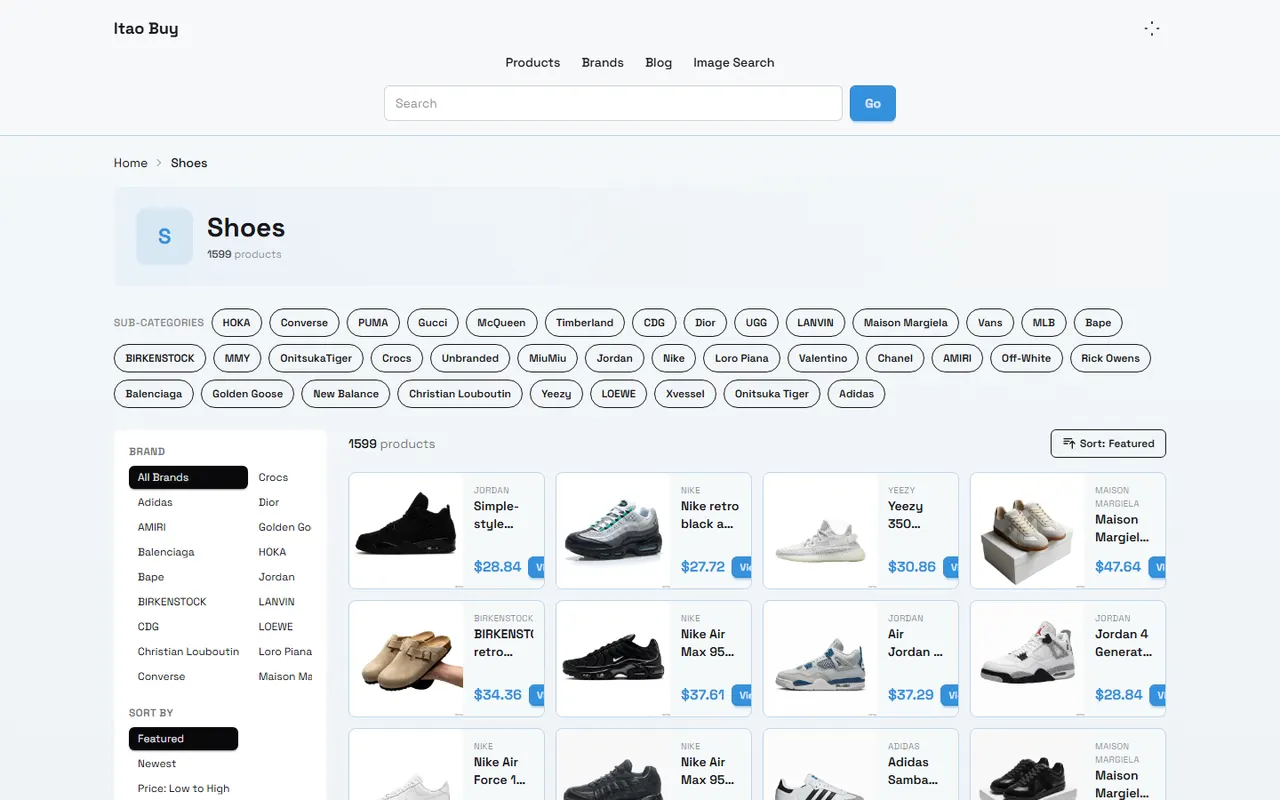
itaobuy Shoes for Commute or Standing
Commuting shoes and standing shoes are not the same issue. Commuting cares more about the rolling feel when walking, weight, wear resistance, and stability on rainy ground; standing cares more about heel support, arch space, replaceable insoles, and foot pressure after long periods of standing. Mixing the two scenarios makes it easy to buy a pair of shoes that look versatile but are actually only suitable for short-distance outings.
The task of this article is specific: to help you, when filtering shoe models on itaobuy, use product page information, size charts, seller images, and QC images after warehousing to determine whether a candidate shoe is more suitable for commuting, standing, or should be replaced. This article does not claim that any shoe has been tested by this site, nor does it judge brand authenticity, inventory stability, or personal fit results; the final decision should still be based on the current product page information and warehouse QC. Verification date: 2026-09-14.
First define the real usage tasks of commuting and standing
Don't start by choosing from shoe names; start by choosing from how you use them in a day.
If your main scenario is subway, bus, walking to the office, the focus is not "soft or not", but whether the sole tends to drag after continuously walking for 20-60 minutes, whether the forefoot can bend naturally, whether the upper will press on the instep, and whether the outsole tread is clear enough on wet ground. 🚇
If your main scenario is standing for long periods in stores, exhibitions, warehouses, medical or service positions, the focus is not just thick soles. When standing, your feet don't constantly shift pressure points like when walking, so heel wrapping, insole support, in-shoe width, and toe room are more important. Shoes that are too soft may feel comfortable at first, but after standing for a long time, they can actually make your feet more tired.
You can first summarize your needs into one sentence:
Daily walking time: less than 20 minutes, 20-60 minutes, or more than 60 minutes
Continuous standing time: less than 2 hours, 2-5 hours, or more than 5 hours
Dressing restrictions: low-key office, uniform matching, casual commuting, or acceptable sporty feel
Ground environment: indoor tiles, outdoor pavement, rainy steps, elevator entrances, or mall floors
Whether you need to change shoes: change into formal shoes at the office, or wear one pair from leaving home to off work
If these answers are unclear, any "recommended commuting shoe" can easily become a guess.
Explain available evidence and boundaries of non-claimable testing
itaobuy's purchasing process usually requires checking product information first, then placing an order to enter the warehouse stage, and then confirming the physical appearance, size marking, color, and visible defects through QC images. Shoes are especially suitable for secondary judgment with QC, because upper shape, sole thickness, heel structure, and workmanship issues are often only visible in physical photos.
But these evidence have boundaries. Product titles, seller images, and parameters can help with initial screening, but cannot prove actual fit; QC images can show appearance, labels, soles, and obvious asymmetry between left and right shoes, but cannot complete long-term wear testing for you. In other words, this article can help you reduce the probability of choosing the wrong direction, but cannot guarantee that a certain shoe is definitely suitable for your foot shape.
Before ordering, you should save this information: product page screenshots, size chart, color options, seller display images, price and shipping pages, after-sales rules, and later QC images. Prices, inventory, routes, taxes, and return windows may change; you should recheck the current page before publishing and before purchasing.
Compare sole thickness, bend, and weight clues by walking distance
For short-distance commuting, you can prioritize appearance and matching, but for medium-to-long-distance commuting, you must look at the sole first. Many thick-soled shoes look taller in photos, but when actually walking, the forefoot may not bend enough and the shoe may be heavy, becoming a burden in the second half of the walk.
For walking less than 20 minutes, as long as the sole has basic thickness and the outsole tread is not completely smooth, it can usually cover short movements between elevators, subway stations, and offices. At this time, you can increase the weight of dressing, such as low-top profiles, solid-color uppers, and materials that are easy to clean.
For walking 20-60 minutes, look at three things: whether the forefoot bend point is close to the toe roots, whether the outsole tread covers the forefoot and heel, and whether the sole is thick enough to isolate the road but not look bulky. If the product images only show large thick hard soles from the side but no sole tread or forefoot structure, wait for QC or ask customer service for supplementary images. 👟
For commuting over 60 minutes, candidate shoes should meet more visible conditions: heel not collapsing, some padding at the opening, sole not extremely flat and thin, upper not relying entirely on hard materials for support. If the product page has no weight data, don't assume "lightweight"; you can make a preliminary judgment based on similar shoe types, sole thickness, and material descriptions, but ultimately it can only be written as a risk warning, not a definite conclusion.
Compare heel support, insole space, and upper wrapping by standing time
The core of standing shoes is not "cloud-like softness", but pressure distribution and foot stability inside the shoe. Too loose will sway, too tight will press; too soft will tire, too hard will hurt.
For continuous standing less than 2 hours, ordinary casual shoes, skate shoes, or low-top sneakers may be sufficient, but avoid obviously narrow toes, ultra-thin soles, and heels with no support. For short standing in the office, going up and down stairs, and lunch outings, the comfort threshold is not that high.
For continuous standing 2-5 hours, heel structure is key. When looking at product images and QC images, note whether the heel has a molded contour, whether the shoe opening has soft padding, and whether the lace area can adjust tightness. If the upper entirely relies on hard leather or hard shaping, people with high insteps may feel pressure; if it's all soft fabric, support may be insufficient.
For continuous standing over 5 hours, it is recommended to prioritize styles with replaceable insoles, wider toe room, and more stable heel wrapping. If you need to use your own insoles, consider the in-shoe height: once the insole is thickened, instep space decreases, and the originally suitable size may become tight. 🧦
Compare low-key appearance, cleaning difficulty, and shoe-changing scenarios by office dress code
Office shoes need to solve not only comfort but also "can they look appropriate for work". Some sneakers are foot-friendly, but with suit pants, long skirts, or business casual attire, they appear too training-like; some white shoes are versatile but have high cleaning pressure, quickly looking old after rainy commutes.
For low-key office commuting, you can prioritize basic colors such as black, gray, white, off-white, navy, but don't just look at color. The thicker the shoe shape, the larger the logo, and the stronger the color blocking, the more casual it tends to look. If the office dress code is more formal, simple low-tops, low-saturation colors, and fewer decorations are more stable.
Cleaning difficulty should also be judged in advance. Mesh is breathable but easily collects dust, suede has nice texture but is not rain-resistant, glossy or synthetic leather is easier to wipe but may be stuffy. If the product page does not specify the material, do not write the image appearance as certain material; after QC, you can judge the texture from close-up photos, but still retain uncertainty.
If you will change shoes at the office, commuting shoes can be more functional: durable for walking, slip-resistant, cushioned, easy to put on and take off. If one pair of shoes needs to go from subway to meeting room, you need to compromise between comfort and appearance; avoid styles that are too outdoor, too exaggerated, or too easily soiled.
Use itaobuy product information and QC images for pre-order verification
When choosing shoes on itaobuy, verification can be divided into two steps: before ordering and after warehousing. Before ordering, decide whether it's worth buying; after warehousing, decide whether to keep, request supplementary photos, or apply for processing.
Before ordering, look at the product page: whether the title clearly indicates the shoe model, whether sizes are complete, whether colors correspond to images, and whether seller images cover the side, toe, sole, and heel. Products with only a single atmospheric image, no size description, and no clear sole image are not suitable to be the main shoe for commuting or standing.
After warehousing, when looking at QC images, check in a fixed order:
Are the left and right shoe colors consistent, and is the shoe shape obviously asymmetrical?
Are there stains, creases, glue separation, or deformities on the toe, side, or heel?
Is the sole tread clear, and is it generally consistent with the product page display?
Does the size marking match the order option?
Are there obvious workmanship issues with the insole, tongue, or opening?
If for standing, focus on whether the heel collapses, whether the opening is thin, and whether the toe area looks too narrow.
QC images cannot tell you how you'll feel after wearing for several hours, but they can screen out a batch of clearly unsuitable candidates. When you find doubts, don't rush to ship; you can request supplementary photos of the sole, heel, size label, or in-shoe space. 🔍
Commuting shoes vs. standing shoes trade-off table
Usage scenario | Priority checks | Clues for more suitable shoe models | Clues to be cautious about |
|---|---|---|---|
Short-distance commuting | Appearance, basic slip resistance, easy cleaning | Low-top, basic colors, sole not too thin | White hard to clean, sole tread too shallow |
Medium-to-long-distance commuting | Forefoot bend, weight feel, outsole tread | Sole cushioned but not bulky, heel stable | Extremely thick sole, hard sole, product images lack sole details |
Office standing | Heel support, insole space, toe width | Opening has padding, adjustable tightness, toe not pressing | Narrow pointed toe, ultra-soft collapsed heel, insufficient in-shoe space |
Need formal dress | Color, profile, decorative elements | Low-saturation colors, simple upper, small logo | Exaggerated color blocking, large logo, strong outdoor feel |
Rainy or complex road surfaces | Outsole tread, material, cleaning difficulty | Clear tread, upper easy to wipe | Smooth sole, large suede area, light-colored mesh |
This table is not to make everyone choose the same shoe, but to help you classify candidate shoes: commuting priority, standing priority, office priority, or directly exclude.
Final decision: keep, supplement evidence, or change candidate
After reviewing the product page and QC, you can conclude with three outcomes.
The first is keep. Candidate shoes suitable for keeping should meet your main scenario: commuting shoes should have sufficiently clear sole and walking structure clues; standing shoes should have stable heel, reasonable toe room, and acceptable insole margin; office shoes should also fit into daily dress. ✅
The second is supplement evidence. If the product page looks suitable, but the QC images did not capture the sole, heel, size label, or in-shoe details, request supplementary photos. The cost of supplementary photos is usually lower than regretting after directly sending uncertain shoes in an international package.
The third is change candidate. Consider changing when these situations occur: confusing size information, obvious inconsistency between left and right shoe appearance, collapsed heel, too shallow sole tread, suspected instep pressure without more proof, too large discrepancy between seller images and QC images, or the product page cannot support your basic judgment on commuting and standing.
If the goal is to save money, the appropriate approach is not to buy the cheapest pair, but to reduce returns, re-shipments, and idle shoes. The saved amount comes from fewer detours; the increased risk comes from inability to try on, size errors, international return costs, and route restrictions. This method is more suitable for buyers who are willing to look at product pages and QC details and can accept a certain waiting time; it is not recommended for those who need shoes immediately, have special foot shapes without size experience, or must rely on strict after-sales trial wear.
The final judgment can be simple: if you walk a lot daily, choose shoes that can walk; if you stand a lot daily, choose shoes that can support; if you need to meet people daily, choose shoes that can match. Once the usage tasks are sorted out, filtering shoe models on itaobuy will change from "seeing which pair looks pleasing" to "which pair is closer to my real day". 🙂
Agent Platform Shopping FAQ
1. How should I evaluate QC photos on itao-buy.com?
When viewing QC photos on itao-buy.com, it is recommended to focus on the key features of the purchased item. For shoes, carefully inspect the toe, heel, and tongue areas to check if the stitching is neat, the shoe shape is proper, and the tongue thickness meets standards, to judge its quality. For clothing, check details such as neck labels, logo embroidery, fabric texture, and the flatness of collars and cuffs.
2. What types of products can be found in the spreadsheets on itao-buy.com?
The spreadsheets provided by itao-buy.com include various product types, including shoes, clothing, bags, accessories, jerseys, perfumes, hats, scarves, belts, and various household items.
3. What product categories are available on itao-buy.com?
itao-buy.com has a rich product line, covering shoes, T-shirts, sweaters, hoodies, jeans, sweatpants, shorts, beach shorts, factory clearance items, down jackets, baseball shirts, shirts, hats, jewelry, bags, electronics, sunglasses, socks, underwear, and trendy collectibles.
Browse our latest products and find your next favorite item.